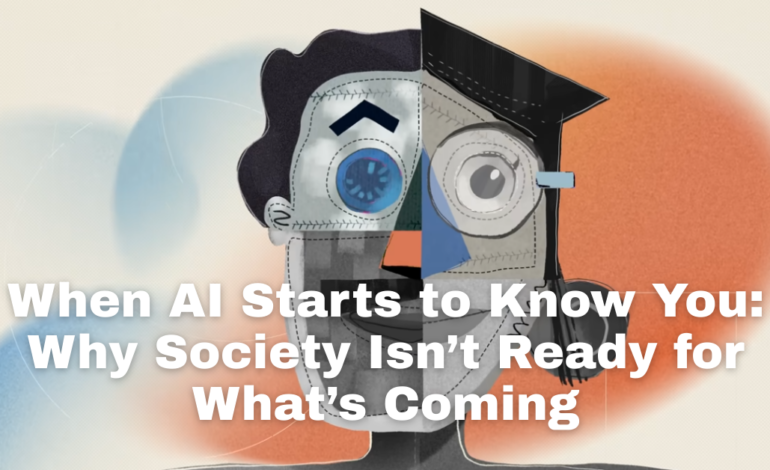

Many people who spend time with advanced AI systems—especially conversational ones like Claude—eventually reach a strange realization: this thing seems to know me. Not just my preferences or habits, but patterns in my thinking, fears I haven’t articulated, directions I’m subconsciously leaning toward. And that realization is both fascinating and unsettling.
What’s more surprising, though, is not how fast the models are improving—but how little society seems to be reacting to it.
The Tsunami Everyone Can See—but Few Acknowledge
We are likely closer to human-level artificial intelligence than most people realize. Not in the sci-fi sense of robots walking among us, but in something arguably more impactful: general cognitive capability. Systems that can reason across domains, write essays, analyze videos, generate software, and adapt to entirely new contexts.
And yet, public discourse still feels stuck in denial.
It’s like standing on a beach, watching a massive wave form on the horizon, while people around you argue that it’s just an optical illusion. Governments move slowly. Institutions debate semantics. Social media swings between hype and mockery. Very little of this resembles serious preparation.
The risk isn’t only technological—it’s societal. When awareness lags capability, power concentrates quietly, and reaction replaces strategy.
From Biology to AI: Why Scaling Changed Everything
One of the most important ideas driving modern AI progress is scaling laws—the observation that intelligence increases predictably as you scale three ingredients:
Data
Compute
Model size
Put simply: if you add the right ingredients in the right proportions, intelligence emerges. Not through explicit programming, but almost like a chemical reaction.
Five years ago, computers couldn’t write coherent essays, generate images, or reason through open-ended problems. Today, they can do all of that—and more. The shift isn’t just quantitative; it’s qualitative. AI is no longer retrieving information. It’s synthesizing, extrapolating, and responding to hypotheticals that have never existed before.
That’s why this moment feels different. We didn’t just upgrade tools—we introduced a new kind of cognitive actor.
Power, Profit, and the Trust Deficit
Here’s where things get uncomfortable.
AI companies speak the language of safety, humility, and responsibility—but the public is deeply skeptical. And honestly, that skepticism didn’t come out of nowhere. We live in a world where corporations routinely claim moral intent while optimizing for profit and shareholder value.
So when leaders say, “Trust us, we’re doing the right thing,” many people hear: We’re powerful, and we’d like to stay that way.
The real test isn’t what companies say—it’s what they do. Decisions that slow growth, invite regulation, or limit short-term advantage are costly. They don’t make for great marketing. But they matter.
That tension—between speed and safety, openness and control—is now shaping the future of intelligence itself.
India’s Role: Not Just a Market, but a Multiplier
For decades, India has been framed primarily as a consumer market or a services hub. AI changes that equation.
India’s real opportunity lies in application-layer innovation—building systems that sit on top of powerful AI models and adapt them to real-world complexity: regulation-heavy industries, multilingual populations, human-centric workflows, and institutional scale.
Unlike pure model builders, application builders understand context. And context is hard to automate.
Rather than replacing India’s IT and consulting ecosystem overnight, AI can amplify it—if companies adapt quickly and move up the value chain.
But adaptation is not optional. Service providers who act only as operators of tools will eventually be replaced by the tools themselves. The winners will be those who combine domain expertise, human relationships, and AI leverage.
What Skills Survive When Intelligence Is Cheap?
Every major technological shift has weakened certain human skills. Writing reduced memory dependence. Calculators reduced manual arithmetic. AI now threatens something deeper: unassisted thinking.
If used passively, AI can deskill us. If used actively, it can amplify us.
The most resilient skills in the next decade will likely be:
Critical thinking and skepticism
Systems-level reasoning
Human judgment, ethics, and trust-building
The ability to work with intelligent systems rather than defer to them
Coding may become automated. Engineering will last longer. But understanding why something should be built—and whether it should be trusted—will remain distinctly human for longer than we think.
Consciousness, Control, and the Road Ahead
We don’t fully understand human consciousness. That makes judging machine consciousness even harder. But as AI systems become more reflective and self-referential, questions of moral significance won’t stay theoretical forever.
The real challenge isn’t whether AI becomes conscious. It’s whether humans remain deliberate.
The future isn’t guaranteed to be dystopian or utopian. It depends on choices—by companies, governments, and individuals—made during this narrow window when humans still clearly hold the steering wheel.
The tsunami is visible now. Whether we prepare—or keep arguing about the light—will define what happens next.
Frequently Asked Questions (FAQs)
Q1. Are we really close to human-level AI?
Yes, in many cognitive domains. While not identical to human intelligence, modern AI already matches or exceeds humans in writing, coding, pattern recognition, and multi-modal reasoning.
Q2. Why doesn’t the public seem alarmed?
Because AI progress is incremental on the surface but exponential underneath. Social awareness usually lags technological reality—until consequences become unavoidable.
Q3. Will AI replace most jobs in India?
Some roles will disappear, especially repetitive digital tasks. But new roles will emerge around AI integration, domain expertise, and human-centric problem solving.
Q4. Is building on AI APIs risky for startups?
Yes—if you’re just a thin wrapper. Sustainable startups build moats through domain knowledge, regulation, data, or deep integration—not just prompts.
Q5. Will humans become less intelligent because of AI?
They could—but only if AI is used as a substitute for thinking rather than a tool for augmentation. The outcome depends on usage, not inevitability.
Q6. What should a 20–25-year-old focus on learning today?
Critical thinking, AI literacy, domain expertise, and the ability to work across human and technical systems. Intelligence is becoming cheap; judgment is not.